
ARC PRISM / PIX
Start with
the whole picture.
Turn a raw video into a timed sequence of observations. Preserve the frames, camera context, and source information that every downstream analysis depends on.
VISUAL PERCEPTION
- START WITH
- Raw video and available camera metadata
- WORK TOWARD
- Timestamped frames and capture metadata
- CONNECTED TO
- Every Prism analysis module
Inside pixel understanding.
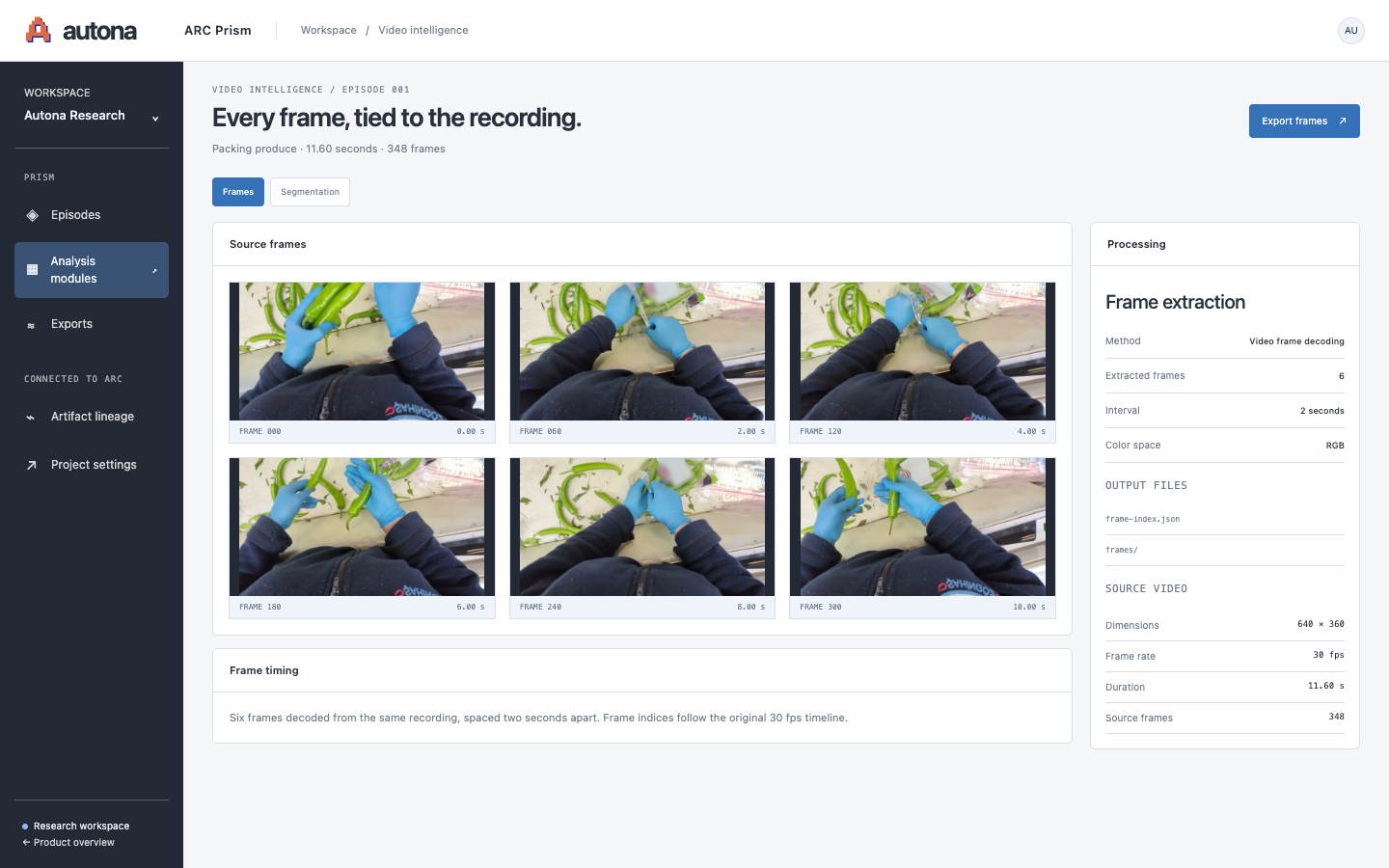
Frames decoded from one recording, with their original timestamps and frame indices.
A reliable starting point
for every signal.
Segmentation, motion, and language need to agree about the same moment. Pixel understanding establishes the frame and timing foundation that makes their outputs comparable.
Import the recording
Bring in egocentric or scene video and any available camera metadata.
Inspect the sequence
Review frame timing, image dimensions, coverage, and the portions useful for analysis.
Pass frames forward
Supply a consistent input sequence to the selected perception, motion, and spatial modules.
The module prepares observations. Semantic descriptions, depth, and object identity are produced by the analysis methods connected to those observations.
Make every frame part of the system.
Tell us about the footage, environment, and outputs your team needs.